

By Ping Han on Aug 19, 2026, 12:07:27 PM
.png)
Every week I get sent the same headline in a different masthead. Values easing. Clearance rates in the thirties. Buyers back in control.
All of it is accurate. Almost none of it answers the question our landlords are actually asking me, which is not what is the market doing but what should I do about it.
Those are different questions, and the second one has a much better answer than the first. Wearing my CPA hat, here is how I'd work through it.
You are probably not in the market you're reading about
The 12 May 2026 Budget drew a line through the investor market, and the line is permanent.
Own an investment property — or hold a signed contract — from before 7:30pm AEST on that date, and your negative gearing is grandfathered. Rental losses keep offsetting salary and other income for as long as you hold the asset. That is law now, not a proposal.
Buy an established residential property after that moment and, from 1 July 2027, losses are quarantined: deductible only against residential rental income or capital gains from rental property, with the excess carried forward.
The part that matters most is this. Grandfathering attaches to the property. Not to you, not to your loan. Sell, and you cannot buy the entitlement back at any price. CommBank's own housing outlook called this what it is — a lock-in effect that gives existing owners a reason to hold rather than list.
So if the slow market has you thinking about selling, start by pricing what you'd be handing over. It isn't only the asset.
But grandfathered doesn't mean untouched
Here's where I'd push back on some of what I'm reading.
Negative gearing is protected. Capital gains tax is not, or not entirely. From 1 July 2027 the 50% discount is replaced by cost base indexation with a 30% minimum tax rate. You keep the 50% discount on the gain accrued up to that date; the new regime applies after it.
For a genuine long-term holder, most of the gain sits on the right side of the line. But it changes the arithmetic on anything you might otherwise sell in five or ten years, and it makes your valuation position at 1 July 2027 worth documenting properly. That's a conversation to have with your accountant before the date, not after.
The real shift: from tax-driven to cashflow-driven
For thirty years a good share of Australian property investment has been underwritten by the tax office. That subsidy is being withdrawn from new established-stock purchases, and the market is repricing in front of us.
You can see it in the lending. Investor loan commitments fell 8.6% over the June quarter and sit close to 15% below a year ago. Herron Todd White found widespread expectation among property professionals that investors would either sell down or stop buying altogether.
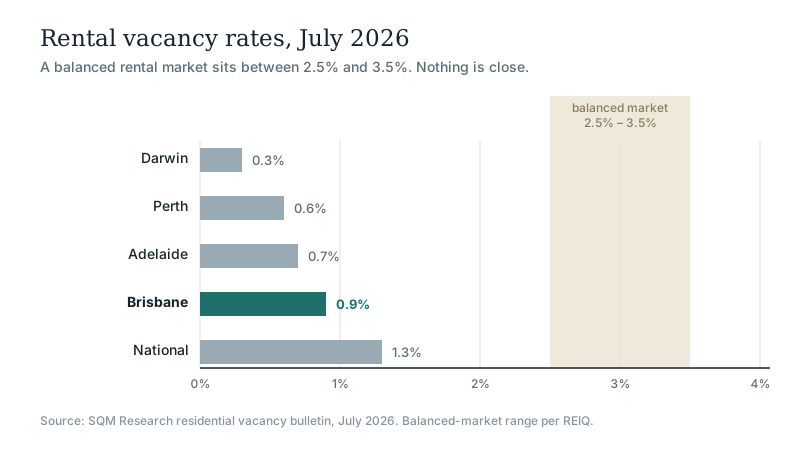
What hasn't shifted is the ground underneath. Brisbane's vacancy rate held at 0.9% through June and July. Every capital is under 2%; five are under 1%.
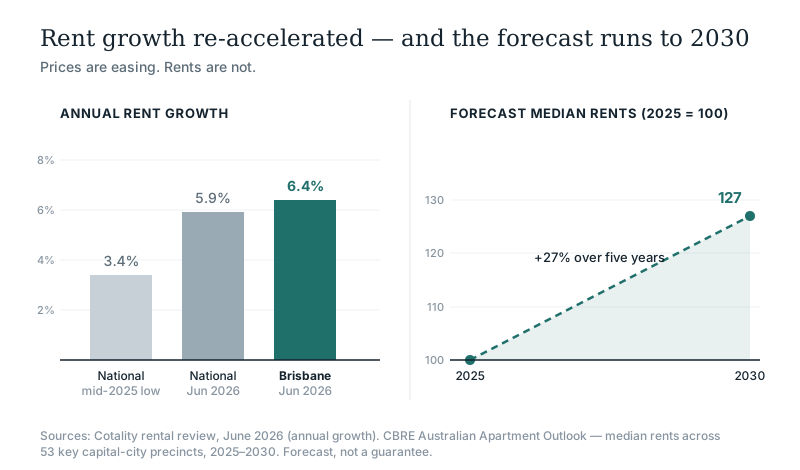
Rents have followed. Brisbane rents rose 6.4% over the year to June, ahead of the national 5.9%, and national growth has re-accelerated from a mid-2025 low of 3.4%. CBRE forecasts median rents across 53 capital-city precincts rising 27% between 2025 and 2030.
Fewer investors buying. No meaningful new supply. A tenant pool that keeps growing.
Which turns the question from hold or sell into something more useful: can I move this asset closer to break-even, and hold it long enough for the shortage to do its work?
Move one: the loan
Switching an investment loan to interest-only is the fastest cashflow lever most landlords have. Rent covers interest and holding costs, the balance stays where it is, and growth compounds quietly in the background.
Two things to know.
Refinancing shouldn't disturb your grandfathering — the entitlement sits with the property, so changing lenders, moving to interest-only, or redrawing for improvements should leave it intact, provided the borrowings still relate to producing rental income. Worth confirming against your own facts, but that's the design.
And it isn't free. Lenders charge roughly 0.30–0.40% above the equivalent principal-and-interest rate, around $2,400 a year on a $600,000 loan. Interest-only periods usually run five years and then revert, and the reversion is a step up rather than a step. Banks also assess existing interest-only debt more harshly when you next borrow.
Interest-only is a timing tool, not a strategy. Used deliberately — to fund improvements, ride out a soft patch, free up capacity for an acquisition — it earns its keep. Used to avoid a hard conversation about whether an asset works, it just postpones one.
Move two: the property
This is the one I'd push hardest, because it's the cheapest and the least used.
Paint and flooring remain the highest return per dollar available on a rental. A tired property in a 0.9% vacancy market still leases. It just leases slower, to a smaller pool, at the bottom of the range, to tenants who move on sooner. Every one of those outcomes costs more than the paint would have.
BMT documented a $60,000 renovation that lifted weekly rent by $150 — a 13% return on the spend — and turned an annual cash loss into a positive position of just over $4,000.
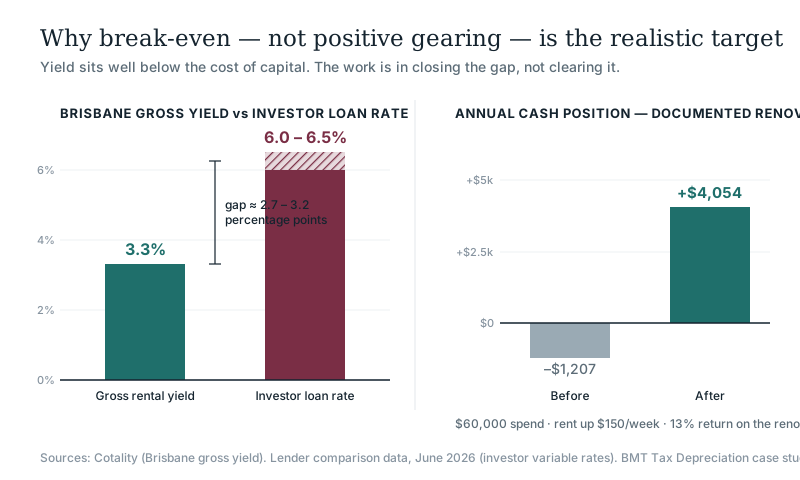
That chart also shows why break-even, not positive gearing, is the honest target. Cotality's head of research has been blunt that gross yields sit well below the cost of capital, and that few locations let a local investor run positively geared under typical leverage. Getting genuinely positive usually takes equity, not optimism.
You don't need $60,000 to move the needle. Paint and new flooring together typically run $6,000–$10,000. A split system is $1,300–$2,500 installed and, in this climate, widens the tenant pool noticeably.
Three things to hold onto:
Renovate to the market ceiling, then stop. Anything above the suburb's rent ceiling enriches a future buyer, not your yield. Your property manager should know where that ceiling sits.
Newer fittings cost less to run. The gain isn't only rent. It's the maintenance calls you don't get, the vacancy weeks you don't wear, and the tenant who stays three years instead of one.
Get the tax treatment right. Repairs are deductible in the year incurred; capital improvements are depreciated. A quantity surveyor's schedule usually pays for itself several times over, and the residual value of what you removed is frequently left on the table.
Move three: buying, with your eyes open
Brisbane values fell 0.6% in July and sit 0.7% below their May peak, still up 14.8% over the year on a median dwelling value near $1.10 million. National vendor discounting has widened to 3.6%. Brisbane's clearance rate touched 35.4% in mid-July.
Buyers have leverage they haven't had in five years, and the investors who'd normally be bidding against you are sitting this one out.
Two honest caveats. An established purchase now sits outside grandfathering — it can still stack up, but it has to stack up on yield and growth rather than on a deduction. And new builds retain full negative gearing plus the 50% CGT discount, which is exactly the behaviour the policy was built to encourage.
One correction worth making
I keep hearing that holding through a company or trust sidesteps the changes. It doesn't.
The measures apply to residential property held by individuals, partnerships, companies and most trusts. The exemptions run to widely held trusts — managed investment trusts and similar — and superannuation funds. A family discretionary trust is not a workaround.
Structure still matters, for income streaming, asset protection, succession, and how losses are quarantined inside the entity. It is not a way around 1 July 2027. If you've been told otherwise, get a second opinion.
Where this leaves you
If you bought before 12 May 2026 and the property sits somewhere with real tenant demand, the case for holding is stronger now than it was a year ago. Not because the market is strong, but because what you hold can't be repurchased.
The work is in the cashflow. Structure the loan deliberately. Spend the $8,000 on paint and flooring. Know your rent ceiling and price to it. Get the depreciation schedule done. None of it is exciting, and all of it compounds.
We manage hundreds of investment properties across Brisbane, and the pattern is consistent. The properties that outperform aren't the ones in the best suburbs. They're the ones kept in good condition and leased to good tenants who stayed.
If you'd like us to look at where your property sits against current market rent, and what it would take to close the gap, we're glad to run through it with you.
Ping Han is Co-Founder and Director of Property Management at Place Sunnybank. This article is general information and not personal tax, financial or legal advice. Your circumstances differ; speak to your accountant or adviser before acting.
Sources: ATO; Treasury Laws Amendment (Tax Reform No. 1) Act 2026; Cotality Home Value Index and Monthly Housing Chart Pack, August 2026; SQM Research vacancy bulletins, June–July 2026; ABS Lending Indicators; CBRE Australian Apartment Outlook; CommBank housing outlook, May 2026; BMT Tax Depreciation.

What last night's Budget means for your investment property
.png)
When Should You Consider Changing Your Property Manager in Brisbane?
.png)